
Most organizations have personas. They’re in a folder somewhere, untouched since the last strategy initiative.
IBM researcher Clare-Marie Karat found that every dollar invested in user experience strategy, including persona development, returns between $10 and $100 through reduced redesign costs and stronger post-launch outcomes. Here’s why using them intentionally matters (Karat, 1994).
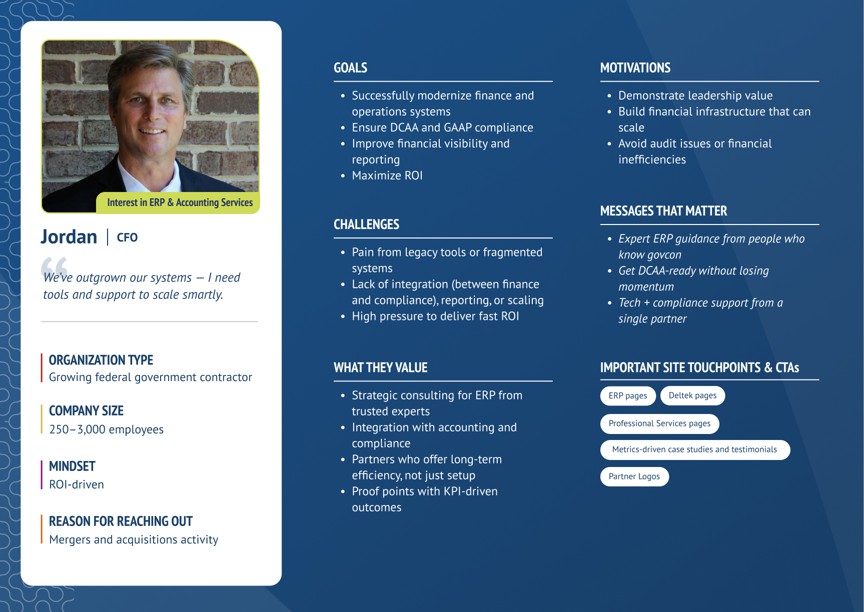
A user persona is a broad generalization of target users grouped by shared attitudes, behaviors, pain points and goals in relation to your product or service. Also called UX personas or design personas, these decision-making tools humanize the people you’re designing for, align teams, and guide decisions.
In practice, they give your entire team; your designers, developers, marketers, and stakeholders; a shared picture of who they’re building for. That shared picture builds internal consensus, establishes a framework for measuring effectiveness, and unifies efforts from marketing to sales; a principle rooted in Alan Cooper's work on interaction design (Cooper, et. al., 2014).
Throughout the rest of the project lifecycle, these personas serve as the backbone and should be referenced when making choices to ensure all roads are leading back to supporting the target personas’ experience.
Why User Personas Fail: 3 Common Mistakes
Mistake #1. Skipping User Persona Development Entirely
While many organizations have undergone a persona exercise at one point or another, some have skipped this step altogether. At the time, saving a few dollars can seem like the smart choice. “I know my clients” is another common thought that deters businesses from investing in this piece of the strategy planning puzzle.
They do know their clients, but individual knowledge doesn’t guarantee team alignment. Nielsen Norman Group has found that when knowledge and assumptions aren’t shared, a lack of common ground creates confusion in decision-making (Salazar, 2018).
3 Specific failure patterns emerge when persona work is skipped:
• The Elastic User: Each individual working on the project; the designer, developer, marketer, stakeholder; will bend and stretch their idea of the ‘user’ to fit their opinion or support their idea. The user becomes elastic and the final product no longer meets the needs of real users.
• Self-Referential Solution: The designers and developers working on the project start to inject their own attitudes and behaviors onto the product and create a solution that makes sense for people like them, which the target user rarely is.
• Edge Cases: If a business has a few specific clients in mind, products can be designed unintentionally for edge case users, over-emphasizing or de-emphasizing functionalities that apply to a larger base of real users and instead serve a few fringe cases.
Mistake #2. Building User Personas and Never Using Them
Possibly the most common case we come across is the underutilized persona.
Personas work, if you work them.
Often, businesses come to us with personas already in hand, created during a past initiative, sitting in a folder. They’re outdated, or they simply aren’t being used to guide decisions.
To stay useful, personas need two things: regular updates to reflect real and changing data, and consistent reference throughout the project lifecycle. Every decision from design and campaign to product direction should trace back to them. When it doesn’t, personas are decoration, not strategy.
Mistake #3. Getting the User Persona Scope Wrong
The third failure is subtler. Let’s say a business has invested in personas and actively uses them throughout projects. They’re ahead of the curve, but if those personas aren’t appropriately scoped, they’ll still steer the work in the wrong direction.
A persona that’s “25–54, interested in wellness, college-educated” is so broad it describes half the internet. That’s not a persona, that’s a demographic.
Too broad, and you design something that in theory pleases several different types of users but lowers each type’s overall user satisfaction; too narrow, or a lack of persona prioritization, and you run the risk of the final product not appropriately emphasizing the features important to the core personas.
Nielsen Norman Group draws a useful distinction: the right persona is specific enough to guide real decisions, and broad enough to represent a meaningful user group, not a single edge case, and not an abstraction (Laubheimer, 2020).
Personas work best when they’re focused on key users while still accounting for the range of real people actually using the product.
How to Use User Personas Effectively: The Ascedia Approach
We recommend developing personas as a part of our strategic planning process before taking on your next project. We believe that good work starts with a strong strategic foundation. Knowing why we’re building something, who we’re building it for, and how it fits into the marketplace and users’ lives helps us create a solution that reaches our end-user's on-site goals and improves your results.
In practice, that means our experience design team using personas to justify design decisions like navigation structure based on real user behaviors. It also means our digital marketing team shaping campaign language to reach niche audiences where they already are, not where we assume they are.
Personas only work if they are developed, used, and appropriately scoped to serve the right target users. If your last three design decisions can’t be traced back to a real user need, that’s where we start the conversation.
Sources
1. Cooper, Alan, et al. 2014. About Face: The Essentials of Interaction Design, Fourth Edition. Indianapolis, IN: Wiley.
2. Karat, C. (1994). A business case approach to usability cost justification. In R.G. Bias & D.J. Mayhew (Eds.), Cost-Justifying Usability. Academic Press.
3. Salazar, K. (2018). Why Personas Fail. Nielsen Norman Group. https://www.nngroup.com/articles/why-personas-fail/
4. Laubheimer, P. (2020). Just-Right Personas: How to Choose the Scope of Your Personas. Nielsen Norman Group. https://www.nngroup.com/articles/persona-scope/


