
In the last newsletter, we talked about what you should consider before putting a new website into your 2027 budget.
Today the topic is: Can AI find, understand and trust your company?
Five years ago, that question probably wasn't part of your website strategy. Today, it should be.
Because the way people find and evaluate companies is changing faster than most companies are changing their websites.
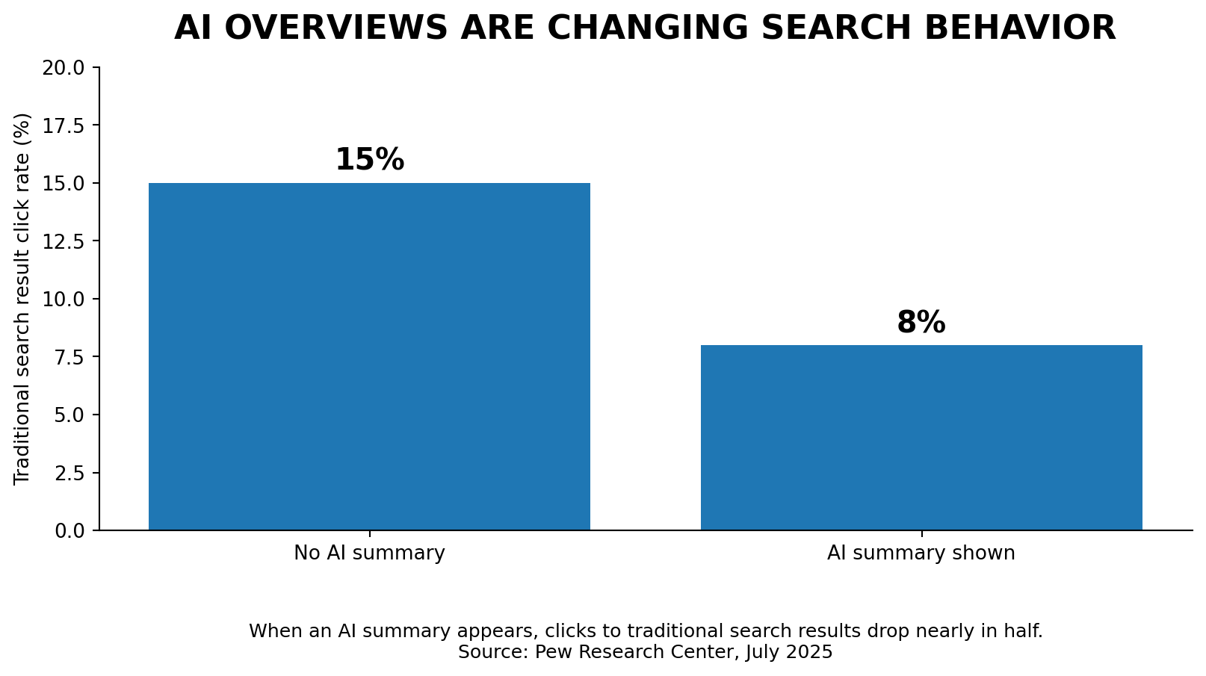
Pew Research Center recently looked at what happens when Google's search results include an AI-generated summary. When there wasn't an AI summary, users clicked a traditional search result 15% of the time. When an AI summary appeared, that dropped to 8%.
This is where we are at.
For years, we essentially built websites for two audiences: people and search engines. We wanted customers to find the site, understand what we did and ultimately take some kind of action. And, of course, we wanted Google to find it too.
Both still matter. But now we've got some new players at the table: ChatGPT, Gemini, Google AI Overviews and AI Mode. And increasingly, AI agents that can interact with websites on behalf of customers.
Your next customer may visit your website. Google may summarize it. ChatGPT may use information from it to answer a question. Eventually, an AI agent may interact with it on someone's behalf.
Your website needs to work in all of those situations. And that is a fundamental shift that has occurred.
Your Website Has a New Job
We've traditionally thought about the website as a destination.
Run an ad, send someone to the website. Rank on Google, get them to the website. Send an email, drive them to the website.
That's still part of the job.
But increasingly, your website is also becoming a source.
It's a source customers use to research you. A source Google uses to understand your business. And a source AI systems may use when answering questions about your company, products or industry.
Let's go back to that Pew research for a minute.
When an AI summary appeared in Google search results, clicks to traditional results dropped from 15% to 8%. People clicked links contained within the AI summaries themselves just 1% of the time.
For years, digital marketing has been built around getting the click. Rank high enough. Write a good title. Give somebody a reason to visit your site.
Now the answer may be delivered before the person ever gets there.
You could look at that and conclude websites are becoming less important. I'd argue the opposite.
Those answers still need to come from somewhere. Your website is one of the primary places where you establish what your company does, what you know and why someone should trust you.
The game isn't simply about getting people to your website anymore. It's also about making sure the information on your website is worth finding and using.
Your Content Has to Earn Its Keep
There's already more content on the internet than any of us could possibly consume. And thanks to AI, we're about to get a lot more.
Google recently published guidance for website owners trying to navigate generative AI search. One of its recommendations was to create "valuable, non-commodity content."
That's a phrase worth remembering.
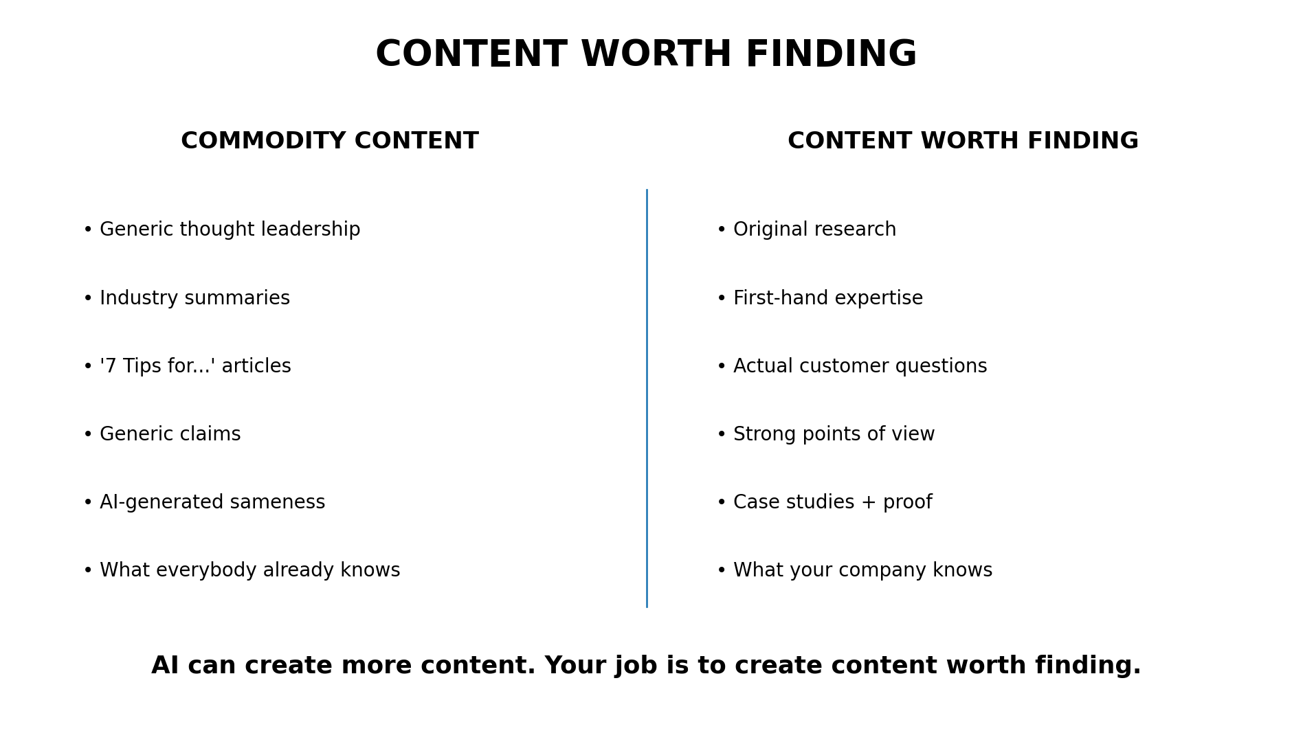
AI can produce generic content all day long. What it can't manufacture from scratch is your company's actual experience.
Your salespeople know the questions customers ask. Your customer service team knows where people get frustrated. Your subject-matter experts know things about your industry that aren't sitting on 500 competing websites.
Your company has customer stories, data, opinions, successes and probably a few scars from learning things the hard way. Use them.
Because there's not much value in filling your website with the same stuff everyone else is saying.
"We provide innovative solutions." "We put our customers first." "We leverage best-in-class technology."
Wonderful. So does everybody else.
Google is encouraging companies to bring unique viewpoints and first-hand experience to their content rather than simply recycling what's already available online.
AI can create more content. Your job is to create content worth finding.
SEO Isn't Dead.
It seems like every six months somebody declares SEO dead. It's not.
Google says the SEO fundamentals we've been using for years still matter in its generative AI search experiences. Your site needs to be crawlable. Technical structure and page experience matters. Useful content matters.
So we're not throwing everything we know about SEO into the dumpster because ChatGPT showed up.
What's changing is how we think about discoverability.
For years, companies have asked: How do we rank on Google?
That's still a good question. But now let’s add another: How do we make sure our company is discoverable wherever our customers are looking for answers?
That might be traditional search. It might be an AI Overview. It might be ChatGPT or Gemini. And two years from now, it might be something none of us are talking about today.
Which is why I'd be careful about chasing whatever AI optimization acronym happens to be popular this month.
Build a technically sound website. Make it easy to understand. Create useful content based on things your company actually knows. That's a pretty good foundation regardless of what comes next.
Some of Your Future Visitors May Not Be People
Google is already providing guidance to website owners about AI and browser agents, systems capable of interacting with websites and performing tasks on behalf of users.
We're early here. An army of robots isn't showing up at your website next Tuesday.
But if you're budgeting for a new site today, you're probably hoping that investment lasts four, five or maybe six years. During that time, software may increasingly interact with websites on behalf of customers.
That makes some pretty unsexy website fundamentals even more important: clear information, logical structure, accessible experiences and technically sound development.
Those things have always been good for people. Turns out they may be pretty useful for machines too.
The temptation right now is to make everything about AI. But that’s not the best way to go.
Your website still needs to be fast. It needs to work on a phone. Navigation needs to make sense. Forms need to work. Security and privacy matter. Your content needs to answer actual customer questions.
And accessibility absolutely matters.
W3C recommends WCAG 2.2 for current accessibility efforts. You don't need to memorize a bunch of WCAG standards to understand the basic point: your website should work for as many people as possible.
The same goes for your technology.
Today's website may be connected to your CRM, marketing automation, ecommerce platform, product information, analytics, personalization, recruiting tools and customer data.
So we're not simply designing pages anymore. We're building a business and marketing platform that needs to play nicely with a lot of other stuff.
AI adds another consideration. It doesn't replace everything else.
Give Your Website the Readiness Test
So, how well does your current website hold up?
We've started thinking about it through four categories.
FIND
Can people, search engines, and AI systems easily find the important information about your company? Or is valuable information buried in PDFs, old pages or parts of the site that are difficult to access?
UNDERSTAND
Can someone quickly figure out what you do, who you serve and the problems you solve? And can a machine do the same?
TRUST
Does your website prove that you know what you're talking about? Are there case studies, customer stories, original research, expert perspectives and useful content? Or are you mostly asking people to take your word for it?
ACT
Once someone finds you, understands what you do and trusts you, is it easy to take the next step? Contact sales. Find a product. Make a purchase. Schedule an appointment. Get an answer.
Find. Understand. Trust. Act.
That's a pretty simple test. Now try it on your current website. See what you find.
Final Words
If you're putting a new website into the 2027 budget, don't simply take the site you have today, give it a new design and call it a day.
The way people find and evaluate your company is changing. Your website needs to change with it.
Make sure people can find you. Make sure they understand you. Give them reasons to trust you. Make it easy to act.
And make sure the site is flexible enough to handle whatever comes next.
Because nobody knows exactly what search, AI or customer behavior will look like five years from now. But we can build websites that are ready to change along with them.
So let me leave you with this: Can your current website be found, understood and trusted in an AI-driven world?
If you're not sure, that's probably worth finding out.
If you're thinking about a new website, or you're simply curious how well your current one holds up, let's take a look. Contact us here.


